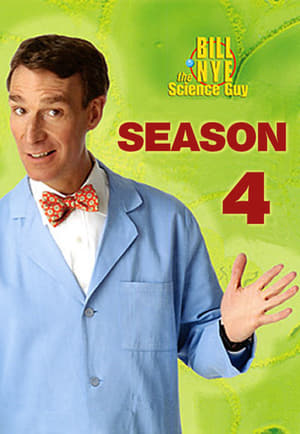
As of July 2026, Bill Nye the Science Guy Season 4 aired in 1995 with 20 episodes. Full episode guide and where to watch below.
Bill Nye the Science Guy Season 4 poster
← Back to Bill Nye the Science Guy

Bill Nye the Science Guy Season 4

1995 20 Episodes Comedy · Documentary ⭐ 7/10

Right now you can watch Bill Nye the Science Guy Season 4 on streaming — and it is funnier than its reputation suggests. The 1-season run is exactly the right length for what it is doing. With 94 viewer ratings on TMDB, this is not a title flying under the radar. Bill Nye sets the tone, and the rest of the cast matches it scene for scene. Available now — press play and find out why people keep recommending it.

Bill Nye the Science Guy Season 4 is not trying to be everything to everyone, and that focus is exactly what makes it work. Bill Nye the Science Guy Season 4 does what great comedies rarely manage — it is actually funny, consistently, across the whole run. Season 4 of Bill Nye the Science Guy includes 20 episodes. It aired from November 1995 to September 1997. This season stars Bill Nye, Rachel Glenn and Toby Lawless. Bill Nye and Rachel Glenn lead a cast that brings real weight to the material. It was aired in 1995. Bill Nye the Science Guy Season 4 earns its laughs from character rather than situation, which is why it does not wear thin the way pure farce tends to. There is real craft here, even in the moments that do not fully land.

If you need a comedy that actually makes you laugh, Bill Nye the Science Guy Season 4 is a strong candidate. It does not lean on comparisons to make its case. It is a manageable watch, easy to fit into a single week. Bill Nye sets the tone, but the supporting cast is where a lot of the best moments come from. A reliable pick for any night you want quality comedy without the homework.

📡 Where to Watch Bill Nye the Science Guy Season 4

Not currently available on major streaming platforms. Check back soon.

TV Butler Pro app
🎩 TV Butler Pro
You find it. Your history remembers it.

🎬 Bill Nye the Science Guy Season 4 — Episode Guide

E1
Rivers & Streams
1995-11-03
Water is massive; rivers are powerful. As rivers flow downhill, they wear away rock and soil to form canyons or winding curves in the land, called meanders. Sometimes rivers fill and overflow their banks. Rivers with too much water create floods that can carry away plants, trees, buildings and bould...
E2
Nutrition
1995-11-10
All food, whether it’s protein, fat, carbohydrates, vitamins, or minerals, is made of chemicals. When your body gets a hold of these chemicals, it recombines them and makes energy. Different types of food make different amounts of energy, which are measured in calories. How do scientists figure out ...
E3
Marine Mammals
1995-11-17
Whales, dolphins, otters, walruses, and orcas are just like us, they’re mammals. Well, they’re not just like us. They live in the ocean. They breathe air, have hair, nurse their babies, and they are warm-blooded. They keep the same body temperature all day. To do that in the ocean isn’t easy. Water ...
E4
Earthquakes
1995-11-24
Earthquakes happen when pieces of land in the Earth’s crust scrape together. The crust of the Earth is made of big slabs of land called plates that are constantly moving just a little bit. The plates scrape by one another, and sometimes they don’t move smoothly. An earthquake happens when the plates...
E5
NTV Top 11 Video Countdown
1995-12-01
Join Bill Nye as he counts down the hits from the Soundtracks of Science. Along with the music, Bill does a few new experiments on the lab bench. You’ll see the grunge band Nyevana’s classic “Air Pressure,” Momentisey’s “The Faster You Push Me,” and divas En Lobe’s “Whatta Brain.” There’s even a spe...
E6
Spiders
1996-01-05
Be sure to get this straight: spiders are not insects, they’re arachnids. Spiders have eight legs, and insects have only six. Spiders have two body parts, a head and an abdomen, while insects have three body parts, a head, a thorax, and an abdomen. Insects have antennae, and spiders do not. Some ins...
E7
Pollution Solutions
1996-01-12
Dirty water, land, and air are a result of pollution. People are the only animals on Earth that make pollution. Garbage, burning fuel, chemicals, sewage, oil, and pesticides are all human-made things that make the Earth’s atmosphere, water, and soil unclean. Humans are even leaving trash in space, s...
E8
Probability
1996-01-19
Probability is a way to measure how likely it is that something will happen. Probabilities are predictions. They’re often just very careful guesses. When a scientist wants to calculate a probability, she or he gathers data and then uses the data to make her or his guess. Probabilities are between 10...
E9
Pseudoscience
1996-01-26
People once thought that world was flat or nearly flat. It was considered a bit crazy to think of it as a big ball. But it is. You can prove it. One of the big ideas in science is that ideas can be tested. Scientists test claims. If one scientist claims that she or he can fill a balloon with invisib...
E10
Flowers
1996-01-27
Flowers are an important part of many plants. Plants use flowers to make other plants – to reproduce. Flowers have special parts, called stamens and pistils. When pollen from the stamen finds its way down through the pistil, the flower is pollinated, and seeds start to grow. The seeds eventually fin...
E11
Archaeology
1996-01-28
Archaeologists are kind of like detectives. They’re scientists who snoop through old or ancient people’s things to find out what life was like thousands of years ago. Archaeologists find ancient cities, tombs, and temples by taking aerial photographs of Earth, by reading old documents, or by just lo...
E12
Deserts
1996-01-29
About 20% of the Earth is a desert. Deserts are places that get very little precipitation (rain or snow) each year, and that makes them extremely dry. Deserts cover big areas of land. The biggest desert, the Sahara, extends from North Africa to Southwest Asia and is 13 times the size of Texas. Some ...
E13
Amphibians
1996-01-30
Frogs, toads, salamanders, newts, and caecilians (worm-like animals that have backbones) are all amphibians, animals that spend part of their lives in water and part on land. Amphibians are slimy. Amphibians are cold-blooded that means their body temperature changes with the temperature outside. And...
E14
Volcanoes
1996-01-31
Volcanoes are mountains made from molten rock. The Earth’s crust is divided into big slabs, called plates, which are slowly moving all the time. The plates are floating on the Earth’s mantle, a layer of gooey hot rock that flows like maple syrup. Some places in the mantle, the rock gets very hot and...
E15
Invertebrates
1996-02-07
Worms, squid, clams, and flies are spineless creatures. They’re not afraid, they’re invertebrates – animals that don’t have backbones. Invertebrates are everywhere. You can find invertebrates in the sea, in freshwater, and on land. There are about 30 times more invertebrates than vertebrates on Eart...
E16
Heart
1996-02-14
Your heart pumps your blood around your body, all hours, every day of the week, to keep you alive. Your heart is about the size of your fist, and it’s made of special muscle called “cardiac” (KAR-dee-ak) muscle. Cardiac muscle lets your heart keep the beat, it can also speed up or slow down, depend...
E17
Inventions
1996-02-21
Almost everything around you, from paper clips to computers, was thought of, designed, and built by humans. An invention can be a totally new idea, or an improved variation on something that already exists. Inventors invent to solve problems and make life easier. Anyone can be an inventor, even you....
E18
Computers
1996-04-25
With special guest, Mick H. Computers are used throughout the world all the time. Computers are in cars, calculators, televisions – you’re even using one right now. Humans use computers to take information – things like pictures, words, numbers, and sound, and turn it into electricity. The informati...
E19
Fossils
1997-09-05
Most dead animals and plants break up, get decomposed, and become part of the soil, but some turn into fossils. A fossil forms when a plant or animal dies, and gets buried. If conditions are right, water gets into the fossil bed, and chemical reactions preserve the impressions for thousands or milli...
E20
Time
1997-09-12
Time affects every living thing on Earth. Trees shed their leaves. Some animals only come out at night. There are even insects that only emerge every 17 years. Days, hours, minutes, and seconds – all of these were invented by humans. Humans came up with these units of time to organize their lives an...

🎭 Cast of Bill Nye the Science Guy Season 4

Bill Nye
Bill Nye
Self - Host
RG
Rachel Glenn
Nancy
TL
Toby Lawless
Family Magician

📋 All Seasons of Bill Nye the Science Guy

Season 1Season 2Season 3Season 5

Never Lose Track of Bill Nye the Science Guy

TV Butler Pro lets you search every streaming service in seconds, tracks what you've watched, and works completely free. No app download needed.

🎩 Try TV Butler Pro Free